CMYK Colour Separation
True process colour separation using four channels: Cyan, Magenta, Yellow, and Black. The most direct method for achieving commercial print quality on white and light garments.
Important note on garment colour
CMYK separation is designed for white or natural garments only. The translucent CMYK inks rely on the white shirt as the paper equivalent. On dark garments, simulated process is the correct choice.
Press requirements
CMYK screen printing requires fine-mesh screens (typically 305–355 mesh), consistent registration, and accurate dot gain profiling. We set the separation parameters to match your production environment.
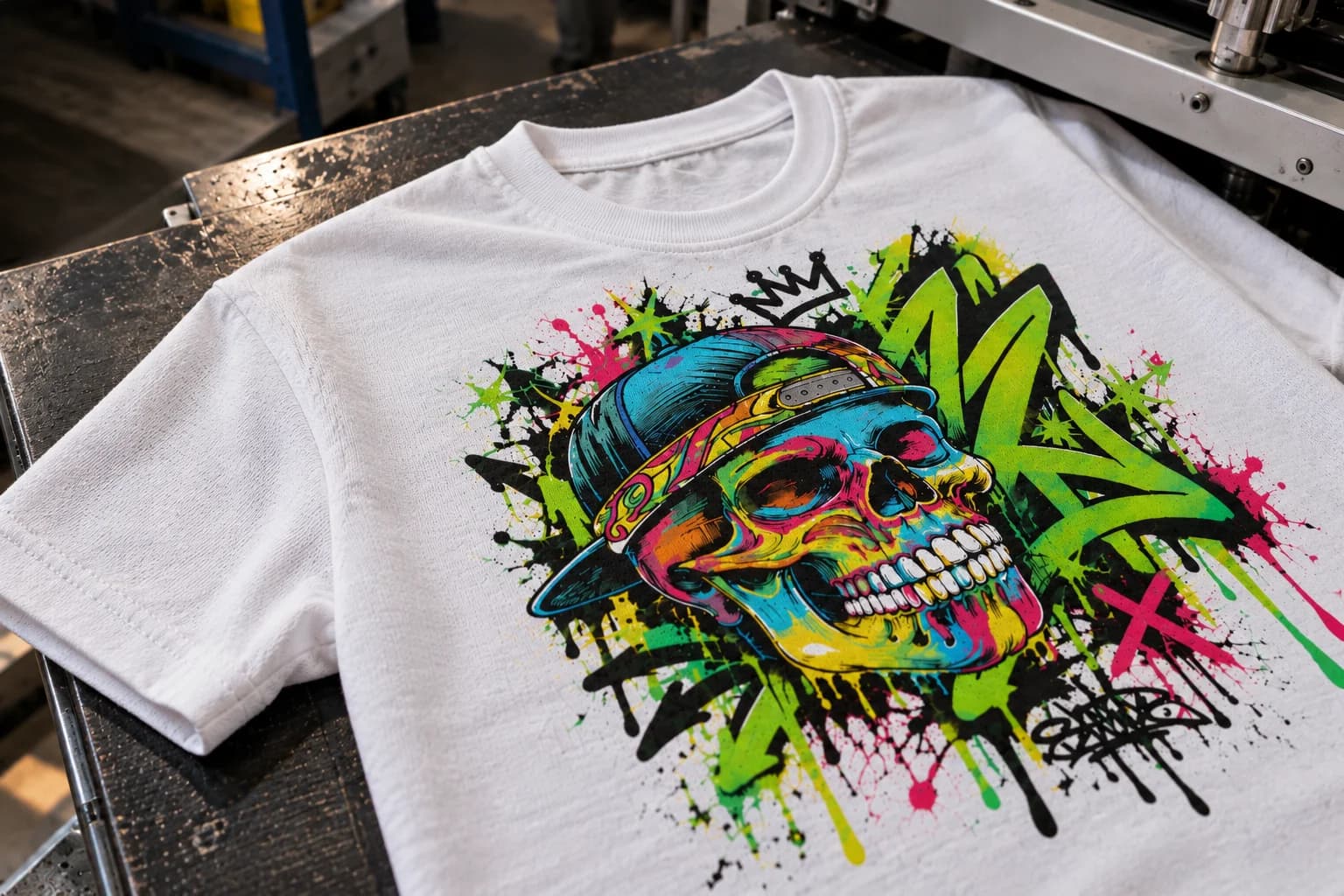
What Is CMYK Separation?
CMYK separation converts artwork from RGB to four process colour channels, the same model used in commercial offset and digital printing. Each channel carries halftone dot information that, when printed in sequence, combines to produce a full-colour result.
UCR (Under Colour Removal) and GCR (Grey Component Replacement) settings control how much black ink replaces combinations of CMY in neutral areas, reducing ink load and improving drying on press.
Halftone angles for each channel are set to the industry-standard offsets (typically C: 105°, M: 75°, Y: 90°, K: 45°) to produce a clean rosette pattern rather than visible dot interference.
Best For
- Photo-quality prints on white or very light garments
- Screen printing setups with process colour inks
- Fine-mesh production environments (305+ mesh)
- Artwork requiring commercial offset-quality results on garment
What We Deliver
- Four CMYK channels with correct UCR / GCR settings
- Halftone angles set to avoid rosette patterns
- Dot gain compensation for your mesh and ink system
- Black channel optimised for depth without ink saturation
- Ready for fine-mesh screen output or direct-to-screen
Is CMYK the Right Choice for Your Print?
CMYK works best for full-colour photographs and illustrations printed on white or very light garments, where the fabric itself acts as the white of the image. Fewer screens than simulated process can make it an efficient option for photo prints on light tees and tote bags.
Before separating, we check the image resolution at print size and how the colours were built. Artwork made in RGB for a screen often contains colours that process inks cannot reach, so we adjust those areas to keep the print bright rather than letting them turn muddy.
Common Questions
Not well. CMYK inks are transparent and rely on a light fabric showing through. For dark garments we usually recommend simulated process instead.